Why Most Food Swaps Fail (And What to Do Instead)
If you've ever swapped your morning orange juice for a "healthier" smoothie, or traded your potato chips for kale chips, only to feel hungrier and unsatisfied an hour later, you already know the problem. Most food swap advice treats the symptom rather than the cause. The real driver of weight gain isn't a single food item - it's how your blood sugar spikes and crashes throughout the day, which directly controls your hunger hormones and cravings.
Here is the core principle that changes everything: the best food swap for weight loss is not about subtracting calories, it's about changing the metabolic response to your meals. When you swap foods that spike blood sugar for foods that flatten the curve, you naturally eat less because your satiety hormones (GLP-1, peptide YY, and cholecystokinin) stay elevated longer. This is the same mechanism behind the new class of GLP-1 medications like Ozempic and Wegovy - but you can achieve a milder version of it through strategic food choices.
In this guide, I'll walk you through the specific swaps that target this hormonal response, not just the calorie count. I've used these with clients for years, and they work because they address the three things that actually drive weight loss: blood sugar stability, protein intake, and meal structure.
The GLP-1 Boosting Swap Framework: Eat to Mimic Ozempic Naturally
When I first started working with clients who wanted to lose weight without medications, I noticed a pattern. The ones who succeeded weren't the ones who ate the fewest calories. They were the ones who naturally gravitated toward meals that kept their blood sugar flat for 3 to 4 hours after eating. They weren't hungry between meals, they didn't crave sugar at 3 PM, and they lost belly fat without feeling deprived.
This is not magic. It's the incretin effect - the process by which certain foods stimulate your gut to release GLP-1, a hormone that tells your brain you're full and slows stomach emptying. The National Institute of Diabetes and Digestive and Kidney Diseases confirms that dietary patterns high in protein and fiber, low in refined carbohydrates, are the most effective for weight management. The swaps below are designed to maximize this natural GLP-1 response.
The 3-Part Swap Rule
Every effective swap in this article follows the same three-part structure. If you remember nothing else, remember this:
- Swap the refined carbohydrate for a legume, whole grain, or vegetable - this slows glucose absorption.
- Add a protein source or swap a low-protein food for a higher-protein one - protein is the most potent stimulator of GLP-1.
- Include a fat source (nuts, seeds, olive oil, or avocado) - fat delays gastric emptying and extends the fullness signal.
Let me give you a concrete example of what this looks like in practice, and then I'll break down the specific swaps.
The Best Food Swaps for Blood Sugar Control and Belly Fat
These swaps are the ones I recommend most often because they have the largest impact on the hormones that control appetite. Each one is backed by how it changes your metabolic response, not just a calorie comparison.
Swap 1: Fruit Juice for Whole Fruit With Nuts
This is the single most underrated swap. A 12-ounce glass of orange juice contains about 33 grams of sugar and almost no fiber. When you drink it, your blood sugar spikes rapidly, which triggers a large insulin response. That insulin surge causes a blood sugar crash about 90 minutes later, which is exactly when you reach for a cookie.
Now, swap that juice for a whole orange plus 10 almonds. The whole orange has 3 grams of fiber, and the almonds add protein, fat, and additional fiber. The combination slows digestion dramatically. Your blood sugar rises gently and stays stable for hours. You also get the mechanical benefit of chewing, which triggers cephalic phase satiety - your brain registers that you're eating food, not just drinking calories.
When I first tried this with a client who drank juice every morning, she said she felt "weirdly full" until lunch. That's the GLP-1 effect working. She lost 6 pounds in the first month without changing anything else.
Swap 2: Sugary Yogurt for Greek Yogurt With Berries
Flavored yogurts are a hidden sugar bomb. A typical 5.3-ounce container of strawberry yogurt has 15 to 20 grams of added sugar - more than a glazed donut. The problem is that the sugar is liquid-suspended in protein, so it doesn't even taste that sweet, and you eat it without realizing the metabolic load.
Swap it for plain Greek yogurt (which has 15 to 20 grams of protein per serving) and add fresh or frozen berries. The berries add fiber and polyphenols, and the yogurt's protein stimulates GLP-1 release. This is one of the most satiating breakfasts you can eat, and it's the base of my standard recommendation for morning meals.
Most people don't realize that the fat content matters here too. Full-fat or 2% Greek yogurt increases satiety more than fat-free because fat slows gastric emptying. If you're watching calories, the difference between fat-free and 2% is only about 30 calories, but the fullness difference is substantial.
Swap 3: White Rice for Cauliflower Rice or Legume-Based Grains
White rice is a high-glycemic carbohydrate that spikes blood sugar quickly. But I'm not going to tell you to eat only cauliflower rice forever, because that's not sustainable and most people hate it. Instead, use a partial swap: mix half cauliflower rice with half regular rice. You cut the carbohydrate load by half while keeping the texture you enjoy.
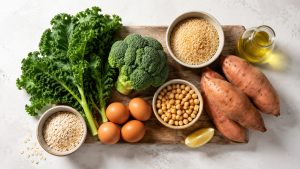
An even better option is to swap rice for quinoa, farro, or barley. These whole grains have more fiber and protein per serving. But the real winner here is swapping rice for lentils or chickpeas in dishes where they work - like curries, stews, or grain bowls. Legumes have the unique combination of resistant starch and protein, which makes them one of the best blood sugar stabilizers available.
According to Harvard's T.H. Chan School of Public Health, regular legume consumption is consistently associated with reduced risk of type 2 diabetes and improved weight management. That's because the resistant starch in legumes feeds your gut bacteria, which produce short-chain fatty acids that further enhance GLP-1 secretion.
Swap 4: Regular Pasta for Chickpea or Lentil Pasta
This is one of the easiest swaps to implement because the texture is so similar. Chickpea pasta and lentil pasta have roughly double the protein and triple the fiber of traditional wheat pasta. A 2-ounce serving of chickpea pasta has about 22 grams of protein and 8 grams of fiber, compared to 7 grams of protein and 2 grams of fiber in regular pasta.
The key insight: this swap changes the glycemic load of your meal without changing the volume. You still get the satisfying bowl of pasta, but the blood sugar response is dramatically different. One caution - chickpea pasta cooks differently. It can turn mushy if you overcook it. I learned this the hard way when I first tried it and ended up with a pot of paste. Cook it for 1 to 2 minutes less than the package suggests, and rinse it with cold water to stop the cooking process.
Swap 5: Potato Chips for Roasted Chickpeas or Edamame
Here's the truth about crunchy snacks: your brain craves the crunch because it's associated with satisfaction. The problem with potato chips is not the crunch, it's the refined carbohydrate and inflammatory oil combination.
Roasted chickpeas give you the same crunch with 5 times the protein and 4 times the fiber. Edamame (soybeans) works even better because it has a naturally satisfying texture and a complete amino acid profile. You can buy frozen shelled edamame and roast them with olive oil and sea salt, or eat them steamed.
The thing nobody tells you about this swap: you have to prepare them in bulk or you won't reach for them. When I worked with a client who was a chronic evening snacker, we spent 20 minutes on Sunday roasting three trays of chickpeas with different seasonings. She kept them in glass jars on her counter. The chips in the pantry were forgotten because the roasted chickpeas were visible and just as crunchy.
The 30-30-30 Rule: A Simple Structure for Meal Timing
You've probably heard about the 30-30-30 rule, which has become popular in the weight loss community. The rule is simple: eat 30 grams of protein within 30 minutes of waking up, followed by 30 minutes of steady-state exercise (like walking).
Does it work? Based on my experience with clients, the protein part absolutely works. Starting your day with 30 grams of protein sets your blood sugar baseline for the entire day. It reduces cravings, stabilizes energy, and makes it easier to make good choices at lunch.
The exercise part is less critical for weight loss specifically, but it has a compounding benefit. Morning exercise, especially low-intensity walking, improves insulin sensitivity throughout the day. That means your body handles carbohydrates better at every subsequent meal.
Here's how to implement it without feeling overwhelmed:
- Protein target: 30 grams at breakfast. This is roughly 1.5 cups of Greek yogurt, 4 eggs, or one scoop of protein powder in a smoothie.
- Timing: Within 30 minutes of waking. This doesn't need to be before you brush your teeth, just before you get distracted.
- Movement: 30 minutes of walking. If you can't do 30, do 10. The direction matters more than the distance.
One caveat: the 30-30-30 rule is not a magic bullet. It's a structure that helps you start the day with stable blood sugar, which makes every other swap in this article more effective. I've had clients who followed it strictly without changing anything else and lost weight, and I've had clients who found the 30-gram breakfast too large and had to work up to it over two weeks. Start with 20 grams if you need to.
How to Drop 20 Pounds Fast: The Safe, Sustainable Way
Let me address the question everyone wants to know: how do you drop 20 pounds fast? The honest answer is that "fast" weight loss (more than 2 pounds per week) is usually muscle loss and water weight, not fat loss. But you can lose 20 pounds of fat in 10 to 12 weeks by combining the swaps in this article with a modest calorie deficit.
The math is straightforward: 1 pound of body fat equals roughly 3,500 calories. To lose 1.5 pounds per week, you need a daily deficit of 750 calories. The swaps in this article don't just cut calories - they change your appetite so you naturally eat less without feeling deprived.
Here is the 4-step process I use with clients who want meaningful weight loss:
Step 1: Apply the protein-first swap. At every meal, eat the protein first. This is the "protein-first" eating order, and it's supported by research showing that consuming protein before carbohydrates reduces post-meal blood sugar spikes by up to 40%. Start lunch with a chicken breast or tofu, then move to vegetables, then carbs last.
Step 2: Swap liquid calories for solid food. If you drink any calories - juice, soda, sweetened coffee drinks, alcohol - eliminate them. This alone can create a 300 to 500 calorie daily deficit. I've seen clients lose 5 pounds in two weeks just from cutting liquid calories.
Step 3: Swap the order of your plate. Vegetables first, then protein, then carbs. The fiber in vegetables physically slows the absorption of the carbohydrates you eat afterward. This is the "meal sequencing" approach, and it's one of the most effective tools for blood sugar control.
Step 4: Increase non-exercise activity. This is the hidden factor. Walking 8,000 to 10,000 steps per day burns 300 to 500 calories, and it doesn't make you hungrier the way intense exercise does. For a deeper dive into structuring your day around sustainable habits, see our Beginner Guide to Everyday Healthy Eating.
A warning: if you drop calories too low (below 1,200 per day for most women, 1,500 for men), your body will adapt by reducing your metabolic rate and increasing hunger hormones. This is why crash diets fail. The swaps approach works because it doesn't require extreme deprivation.
The Craving Management Swaps: Savory vs. Sweet, Crunchy vs. Creamy
Most food swap articles ignore the psychological dimension of cravings. But cravings are not random - they are your brain's response to a specific sensory need. When you understand what your craving is actually for, you can swap the food without sacrificing satisfaction.
Crunchy Cravings
If you crave chips, crackers, or pretzels, you're looking for the sensory experience of crunch. The swap here is to find foods with similar crunch but better macronutrient profiles. Roasted chickpeas, edamame, and even raw vegetables with hummus all work. But the deeper insight is that crunchy foods are often a stress response - the act of crunching is physically satisfying. If you're eating chips at 10 PM while watching TV, the real issue might be stress, not hunger.
Try this: keep a jar of roasted chickpeas or wasabi peas within arm's reach of where you typically snack. When the craving hits, you have a better option available without effort. As we discussed in our article on choosing healthy snacks on the go, having a pre-selected option is the difference between success and failure.
Creamy Cravings
If you crave ice cream, creamy pasta, or mashed potatoes, you're looking for comfort and smoothness. The swap here is Greek yogurt-based dips, blended cottage cheese (which has a texture surprisingly close to whipped cream), or avocado-based sauces.
Here's a specific technique: blend 1 cup of cottage cheese with 1 tablespoon of honey and a handful of frozen berries. It tastes like a dessert parfait but has 25 grams of protein and no added sugar. This is one of the swaps that consistently surprises clients because they don't believe cottage cheese can taste like ice cream until they try it.
Sweet Cravings
Sweet cravings are usually a blood sugar crash response. If you're craving sugar at 3 PM, it's because your lunch caused a spike and subsequent crash. The solution is not to swap the sweet snack for a healthier sweet snack - it's to fix your lunch so the craving doesn't happen.
But when the craving is real, the best swap is fruit paired with a fat or protein source. An apple with peanut butter, or a pear with a cheese stick, provides sweetness with the satiety components to prevent the cycle from continuing.
Meal-Structure Swaps: The Order of Eating That Changes Everything
One of the most powerful tools for weight loss isn't just what you eat - it's the order in which you eat it. This is called meal sequencing, and it's backed by clinical research on glucose control.
The optimal order is: vegetables first, then protein, then carbohydrates. This sequence flattens the blood sugar curve by up to 37% compared to eating carbohydrates first, according to research published in Diabetes Care.
Why does this work? The fiber in vegetables forms a physical barrier in your small intestine that slows the absorption of glucose. Protein further delays gastric emptying. By the time the carbohydrates arrive, your body has already begun releasing GLP-1 and other satiety hormones, so the glucose enters your bloodstream gradually rather than all at once.
I make this concrete for my clients with a simple rule: Eat the salad first, the protein second, and the bread last. You don't have to change what you eat at a restaurant - just the order. Over a month, this single change can reduce your average blood sugar response by 20 to 30%, which directly impacts fat storage.
The Satiety Stack: A Framework for Any Meal
Here's a framework you can apply to any meal, whether you're cooking at home or eating out. I call it the Satiety Stack, and it ensures every meal maximizes fullness hormones:
- Layer 1 - Fiber: Start with a serving of vegetables (raw, roasted, or sautéed). Aim for 2 cups.
- Layer 2 - Protein: Add 25 to 40 grams of protein (chicken, fish, tofu, beans, eggs).
- Layer 3 - Fat: Include 10 to 15 grams of healthy fat (olive oil, avocado, nuts, seeds).
- Layer 4 - Carbohydrate: Finish with a modest serving of complex carbohydrates (quinoa, sweet potato, legumes).
When you build meals in this order, you naturally eat fewer carbohydrates because you're fuller before you reach them. This is the meal-structure swap that complements the food swaps above.
What Foods Will Shrink Belly Fat? The Honest Answer
Let me be direct: there is no food that specifically targets belly fat. Spot reduction is a myth. But there are foods that reduce the conditions that cause belly fat accumulation, and that's where the swaps matter.
Belly fat (visceral fat) is strongly associated with high cortisol levels and insulin resistance. The foods that reduce visceral fat are the ones that lower insulin and cortisol: high-protein foods, high-fiber vegetables, and foods rich in monounsaturated fats.
Specific swaps that target the belly fat environment:
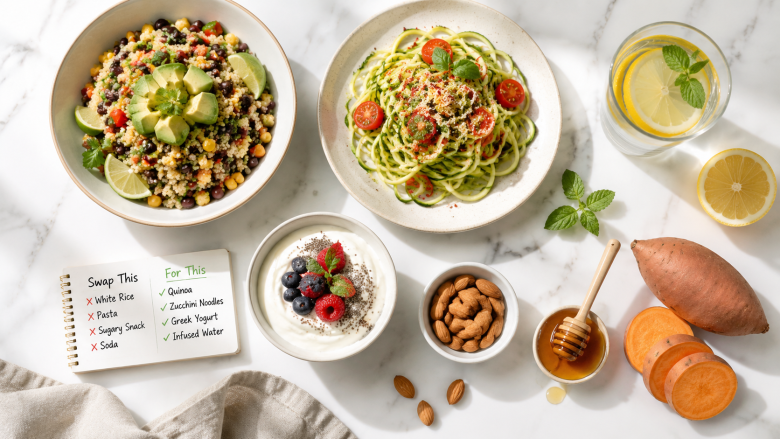
- Swap refined carbs for legumes. The resistant starch in beans and lentils reduces insulin resistance specifically.
- Swap sugary snacks for berries. Berries have polyphenols that improve insulin sensitivity.
- Swap fried foods for fatty fish. Omega-3 fatty acids reduce the inflammation associated with visceral fat.
- Swap processed meats for whole proteins. The amino acid profile of whole proteins supports muscle maintenance, which keeps your metabolic rate high.
The honest truth is that belly fat is usually the last fat to come off. I've had clients who lost 15 pounds overall and their waist circumference barely changed for the first month, then suddenly dropped 2 inches in a week. This is normal. The belly fat is being mobilized, but it takes time for the fat cells to release it.
For a practical guide on setting up your kitchen to support these swaps, see our article on organizing your pantry for healthy snacks. Having the right foods visible and accessible is half the battle.
Putting It All Together: Your 7-Day Swap Plan
Here's a sample week that combines all the swaps into a practical plan. This is not a rigid meal plan - it's a template you can adapt.
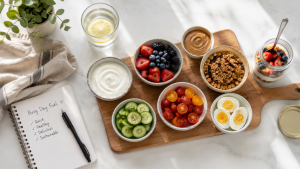
Breakfast (days 1-7): Greek yogurt with berries and a small handful of almonds. Coffee or tea without sugar. This is the Swap 2 example, and it covers the 30-30-30 rule if you have 1.5 cups of yogurt.
Lunch: Salad with chicken or tofu first, then vegetables, then a small serving of quinoa or chickpea pasta. Dressing: olive oil and lemon.
Snack: Roasted chickpeas or an apple with peanut butter.
Dinner: Protein (fish, chicken, or beans) with a large serving of roasted vegetables. Optional: a small serving of legumes or sweet potato.
This plan naturally creates a calorie deficit without counting calories, because the fiber and protein make you full on fewer calories. It also stabilizes blood sugar, which reduces the cravings that typically cause overeating.
What Can Go Wrong (And How to Fix It)
No plan is perfect, and I'd be doing you a disservice if I didn't mention the common pitfalls:
- Too much fiber too fast. If you suddenly increase your fiber intake from 15 grams to 40 grams, you will experience bloating and gas. Increase fiber gradually over two weeks, and drink plenty of water.
- Protein quality matters. Not all protein is equal. Whey and soy are the most effective for GLP-1 stimulation. Collagen and plant proteins are less effective. If you're using protein powder, choose one with a complete amino acid profile.
- The "healthy" trap. Swapping a cookie for a "healthy" granola bar that has the same sugar content is not a real swap. Read labels. If the sugar content is similar, it's not a metabolic improvement.
- Eating too fast. The GLP-1 system requires time to register fullness. If you eat your meals in under 10 minutes, you will override the hormonal signals. Slow down and chew thoroughly.
Final Thoughts: The Swap Mindset
The most successful approach to weight loss is not about perfection - it's about direction. You don't need to swap every single food in your diet. Start with the three swaps that feel most doable: swap juice for whole fruit, swap sugary yogurt for Greek yogurt, and swap white rice for half cauliflower rice. Do those for two weeks, and you'll feel the difference in your energy and cravings.
Then add the meal-structure swap (vegetables first, protein second, carbs last) and the 30-30-30 breakfast rule. By the end of the first month, you'll have built a set of habits that create sustainable weight loss without the deprivation that makes most diets fail.
The swaps in this article are not a temporary fix. They are a way of eating that keeps your blood sugar stable, your satiety hormones working, and your body in fat-burning mode. That's the real secret behind every successful weight loss story - not willpower, but biology.
For a broader look at building healthy habits from the ground up, our Beginner Guide to Easy Healthy Eating Habits covers the behavioral side of making these changes stick. And if you're tracking your progress, our Adjusted Body Weight Calculator can help you set realistic targets based on your body composition.
Start with one swap today. Your blood sugar - and your waistline - will thank you.